

How to Get Started with HandyManCan — Step-by-Step Appliance Diagnosis Tutorial
Written by William A. Plumstead III, appliance technician. Published . Last reviewed .
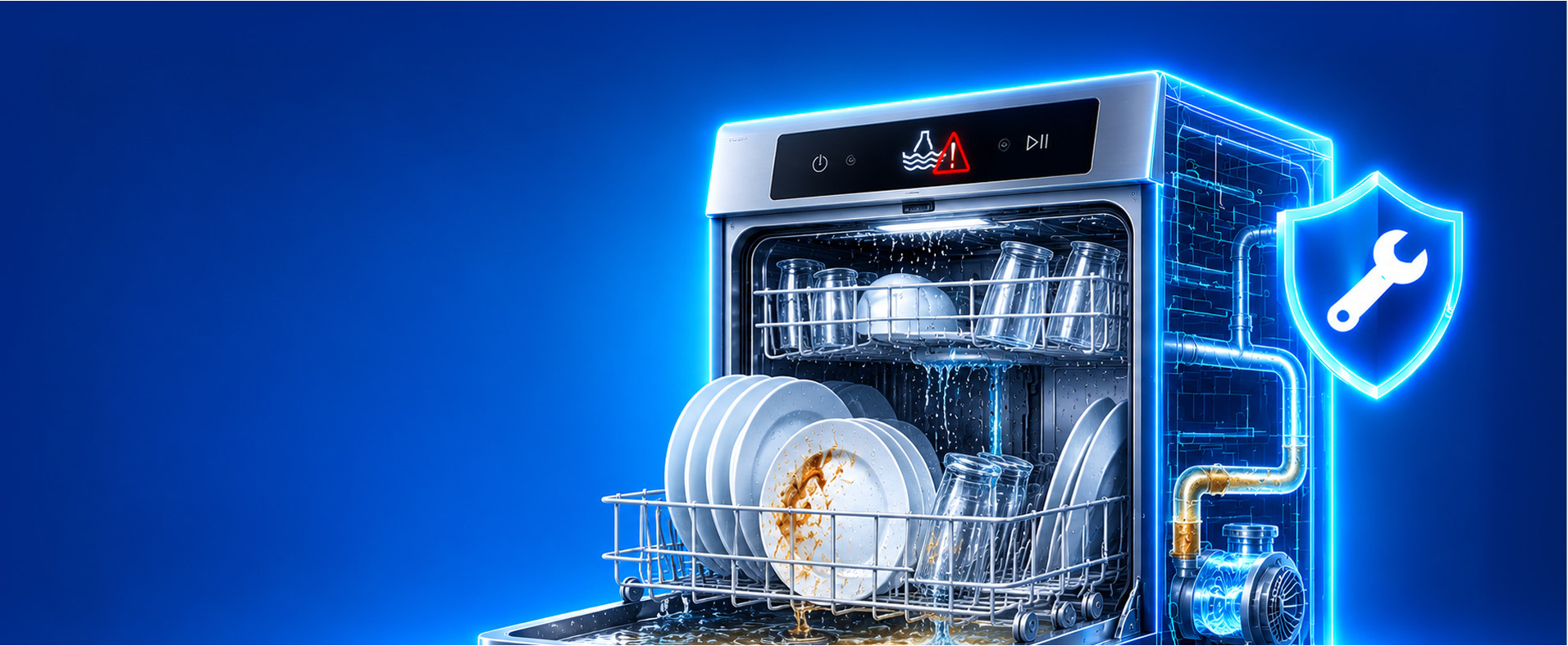
Many dishwasher problems are not broken parts at all. A blocked filter, the wrong detergent, a control lock or a delay start can each look exactly like a failure, and they cost nothing to rule out. When a part is at fault, the moment the problem happens, during filling, washing, draining or drying, usually points to which one.
Why is there water left in the bottom of my dishwasher?
A dishwasher that won't drain usually has a blocked filter, or a problem with the drain hose or air gap. If a waste disposal was recently installed, its knockout plug may still be in. Less often, the drain pump or the check valve has failed.
A small amount of water in the very bottom can be normal. Standing water above that is not. Check whether the filter is visibly clogged, and listen for a hum during the drain step. A new disposal with the plug left in looks exactly like a failed pump.
You can clean the filter and check the disposal inlet, as your owner's manual describes. Anything past that is a technician's job.
Why are my dishes still dirty after a full cycle?
Dishes that come out spotted, filmed or still dirty usually mean too little water is getting in, the water isn't hot enough, or the spray arms are blocked or not turning. Loading that blocks the spray, the wrong detergent, old detergent, or a blocked filter can also cause it.
Go through the cycle in order. Most dishwashers drain first, so hearing a drain at the start is normal. Then listen for water coming in. During the wash, carefully open the door and feel whether it is hot inside. With the power off, turn each spray arm by hand and check that tall items aren't in its way.
You can check the loading, spin the spray arms, clean the filter, and check your detergent and rinse aid. If it still cleans badly, the heating or the water supply needs a technician.
Why is my dishwasher leaking?
Most dishwasher leaks come from too many suds, usually from the wrong detergent. After that, the usual causes are the door gasket, a spray arm hitting something, the water inlet valve or float, or a hose or fitting.
Notice whether it leaks during filling or during washing, and look for suds. Hand dish soap in a dishwasher makes suds that push water out past the door. Check that the door gasket isn't torn or out of place, and that the dishwasher is level.
If it is actively leaking, stop the cycle and turn off the water valve under the sink. If the floor is wet, switch the dishwasher off at the breaker before touching anything.
Why won't my dishwasher start?
When the buttons respond but the cycle never begins, the cause is often a setting: the control lock is on, or a delay start is set. Otherwise it is usually the door latch, a tripped breaker, or less often the control board.
Rule out the settings first, because on a dishwasher they mimic a failure more often than anything else. Check for a control lock and a delay start, make sure the door latches firmly, and look for an error code.
You can check the settings and the breaker. A door latch or control board is a technician's job.
Why are my dishes still wet at the end of the cycle?
Dishes that stay wet are often down to the settings: heated dry isn't selected, or there is no rinse aid. If those are fine, the heating element, its thermostat, the control or the vent fan may have failed.
Feel the dishes as soon as the cycle ends. Hot but wet points to the drying method, such as rinse aid or the dry setting. Cool and wet points to the heating circuit. Plastic items stay wetter than china even when everything is working, so wet plastic alone is not a sign of a fault.
You can check the dry setting and top up the rinse aid. The heating circuit is a technician's job.
Why is my dishwasher making a grinding or knocking noise?
A regular tapping during the wash is usually a spray arm hitting a dish, a utensil or the rack. Grinding during the wash points to the circulation pump. Grinding during draining points to the drain pump. Humming can mean a stalled motor, and a short hiss while filling is often normal.
Notice which part of the cycle the noise happens in, because that tells you more than how it sounds. The wash pump and the drain pump are different parts, and the timing separates them.
You can stop the cycle, let everything come to rest, check the loading, and turn the spray arms by hand with the power off. If the grinding continues, or you smell burning, it needs a technician.
When should I stop and call a technician?
- Water on the floor or standing in the tub near anything electrical. Stop the cycle, turn off the water valve under the sink, and switch off at the breaker before touching anything.
- A burning smell, constant grinding, or a leak you can't stop. A stalled pump motor heats up. Switch off at the breaker and don't run the dishwasher again to see if it repeats.
- Anything on the electrical side: the control board, the door switch, the wiring or the heating element.
How do I keep my dishwasher cleaning well?
Remove and rinse the filter once a month, more often with heavy use. Whenever cleaning gets worse, turn each spray arm by hand with the power off to check it spins freely, and clear any blocked holes. Load tall items where they can't block the arms. A blocked filter and a fouled spray arm are the two most common reasons a dishwasher stops cleaning well, and both take minutes to fix.
How our diagnostic helps
Send us a photo of the model plate, a few photos of the dishwasher, and a short video of the problem. We work out which of these faults it is, give you a written repair plan with the likely parts for your exact model, and tell you plainly whether it's safe for you to fix.
A HandyManCan diagnosis costs $40, charged once, for one appliance and one fault. If we cannot reach a diagnosis, the fee is refunded in full.
Start a Diagnostic$40 one-time fee. No subscription. Full refund if we cannot diagnose it.
Questions about price, refunds or how it works? See our FAQs.
In Virginia's Shenandoah Valley? We also offer in-home repair.
Other Appliances
Washer not draining or spinning
Learn More
Dryer not heating or taking too long
Learn More
Refrigerator not cooling
Learn More
Freezer not freezing or frosting up
Learn More
Oven not heating or holding temperature
Learn More
Range dead or showing an error code
Learn More
Cooktop burner not lighting or heating
Learn More