

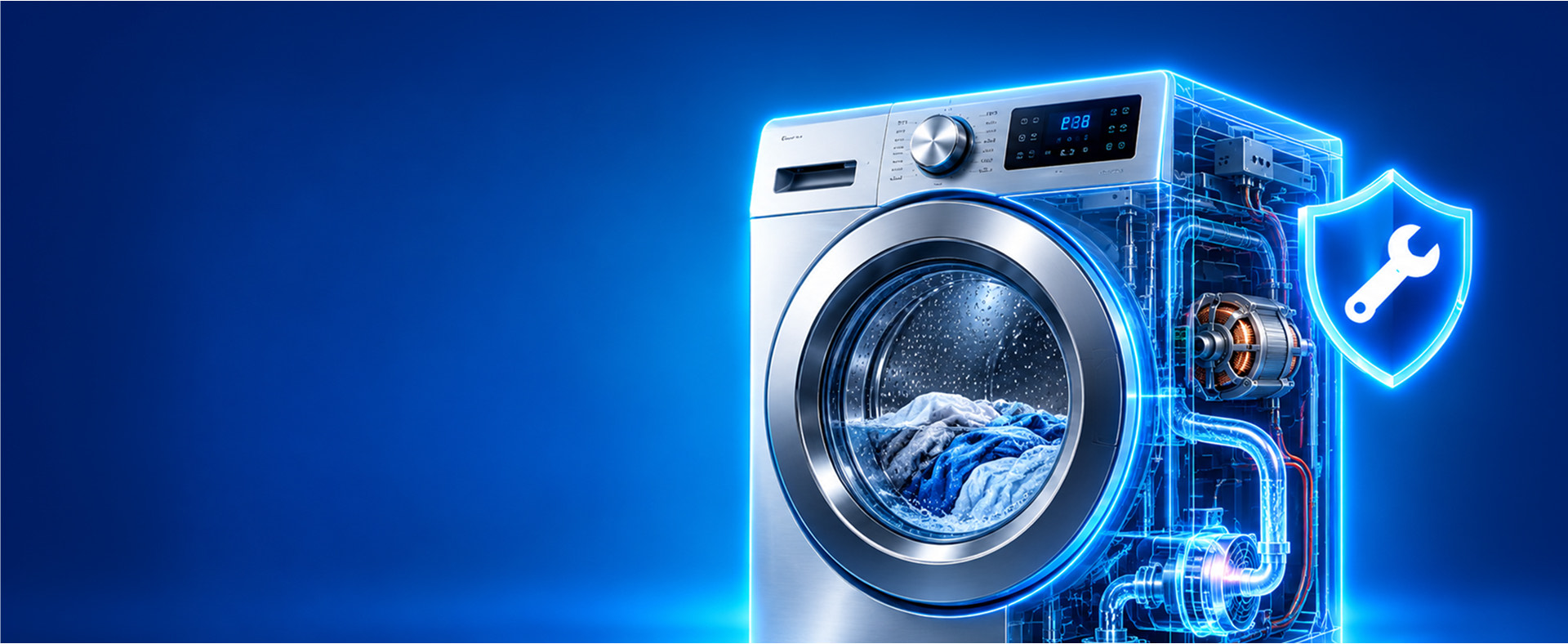
How to Get Started with HandyManCan — Step-by-Step Appliance Diagnosis Tutorial
Written by William A. Plumstead III, appliance technician. Published . Last reviewed .
Most washer faults come down to a short list. A blocked pump or a kinked drain hose stops it draining. A lid lock or drive problem stops it spinning. A hose, inlet valve or door boot makes it leak. When the problem happens, whether during filling, washing, draining or spinning, usually tells you which part is involved before anything is taken apart.
Why won't my washer drain?
A washer that won't drain usually has a blocked pump or filter, or a drain hose that is kinked or pushed too far down the standpipe. Less often, the drain pump itself has failed.
Listen during the drain step. A hum means the pump is getting power but is jammed or restricted. Silence points to the pump, its wiring or the control. Check the display for an error code, and notice whether it drains slowly or not at all.
You can check the drain hose behind the machine for kinks and read the display. Opening the pump or testing wiring is a technician's job.
Why won't my washer spin?
Most often the water never drained, so the spin never started. After that, the usual causes are a lid or door lock that isn't engaging, a worn drive belt or shift actuator, or worn suspension.
Check first whether water is still in the tub. If it is, you have a drain problem and the spin is only a symptom. Listen for the lid lock clicking, and look for an unbalance code or heavy shaking.
You can rebalance the load and check the spin setting. Beyond that, it's a technician's job.
Why is my washer leaking?
Washer leaks usually come from a supply hose or fitting, the inlet valve, or the detergent dispenser. On a front loader, the rubber door boot is a common cause. Less often it is the pump or the tub seal.
When it leaks tells you more than where the puddle is, because water travels before it shows. A leak while filling points to the inlet side. A leak while washing points to the door boot or dispenser. A leak while draining points to the drain hose or pump. Too much detergent can also push suds and water out.
Stop the cycle, turn off the water supply valves, and take a photo of the wet area. Tracing a leak inside the cabinet is a technician's job.
Why won't my washer lid unlock?
A washer that won't release its lid usually still has water inside, which keeps the lock engaged. Otherwise the lid lock or latch has failed, or a drain fault has left water behind.
Look for water in the drum, and think back to whether the power went off mid-cycle. Clicking from the lock suggests a latch or alignment problem, but it doesn't prove it.
Don't force the lid. Forcing it breaks the latch and turns one repair into two. Use only the reset procedure in your owner's manual.
Why does my washer keep filling with water?
A washer that won't stop filling has either an inlet valve stuck open, or a sensing fault: the pressure hose, water-level sensor or control board telling the valve to keep going. A badly placed drain hose can also siphon water out, so the machine keeps refilling.
Turn the washer off and unplug it while watching the tub. If water keeps coming in with no power, the inlet valve has failed mechanically and cannot close. If the water stops, the valve is fine and the fault is on the sensing or control side. This one test avoids buying a valve you don't need. A valve can even pass an electrical meter test and still not close, because the meter tests the coil, not the valve.
You can do the unplug test and turn off the water supply valves. Leave the electrical testing to a technician. If the washer won't fill at all, first check that both supply valves are fully open.
Why does my washer shake or walk across the floor?
Most washers that bang and walk on spin are overloaded or unevenly loaded, standing on uneven feet or a flexible floor, or have weak suspension rods or shock absorbers. On a new front loader, the shipping bolts may still be fitted.
Does it happen with every load, or only with heavy items like blankets and towels? Check that all four feet are firmly down and the machine doesn't rock. A steady roar or grind, rather than banging, points to the bearings or the drive.
Pause the cycle, spread the load out and check the feet. Never reach into a spinning tub.
When should I stop and call a technician?
- Water on the floor near the outlet or wiring. Stop the cycle and turn off the water. Don't stand in the water to reach the plug. Switch off at the breaker instead.
- A burning smell, smoke or sparks. Switch off at the breaker and leave the washer off. Don't run it again to see if it happens twice.
How do I stop my washer from walking?
Check that all four leveling feet are firmly down and the washer doesn't rock, when it is installed, after any move, and whenever it starts moving on spin. Keep loads within the drum's rating, and don't wash a single heavy item like a rug on its own. On a new front loader, make sure the shipping bolts were removed. Most walking washers have a leveling or loading problem rather than a broken part, and the shaking wears out the suspension and bearings if it is left.
How our diagnostic helps
Send us a photo of the model plate, a few photos of the washer, and a short video of the problem. We work out which of these faults it is, give you a written repair plan with the likely parts for your exact model, and tell you plainly whether it's safe for you to fix.
A HandyManCan diagnosis costs $40, charged once, for one appliance and one fault. If we cannot reach a diagnosis, the fee is refunded in full.
Start a Diagnostic$40 one-time fee. No subscription. Full refund if we cannot diagnose it.
Questions about price, refunds or how it works? See our FAQs.
In Virginia's Shenandoah Valley? We also offer in-home repair.
Other Appliances
Dryer not heating or taking too long
Learn More
Refrigerator not cooling
Learn More
Freezer not freezing or frosting up
Learn More
Dishwasher not draining or cleaning
Learn More
Oven not heating or holding temperature
Learn More
Range dead or showing an error code
Learn More
Cooktop burner not lighting or heating
Learn More