

How to Get Started with HandyManCan — Step-by-Step Appliance Diagnosis Tutorial
Written by William A. Plumstead III, appliance technician. Published . Last reviewed .
A range is an oven and a cooktop in one cabinet, so the first question is how much of it has stopped. If everything is dead, look at the power supply. If the display works but nothing heats, an electric range has usually lost half of its power. If only the oven or only the burners have failed, the fault is in that half. For oven-only faults see our oven page, and for burner faults see our cooktop page.
Why is my range completely dead?
A range with no display, no lights and no heat has usually lost its power supply: a tripped breaker, a failed outlet, or a burned connection where the power cord meets the range. A gas range needs electricity too, for its igniters and controls.
Check the breaker panel. An electric range uses a double breaker, and both halves must be on. A gas range plugs into an ordinary 120-volt outlet, so test that outlet with a lamp. Check whether there was a recent power cut or storm.
You can reset the breaker once by switching it fully off and back on. If it trips again, leave it off. The cord, terminal block and wiring behind the range are technician work.
Why does my electric range have power but nothing heats properly?
An electric range where the clock and lights work but the oven and burners stay cold or only get warm has usually lost one half of its 240-volt supply. The controls run on one half and the heating elements need both.
Check the double breaker for the range. One side can trip or fail while the handle still looks on. Notice whether every burner is weak, which points to the supply, or only one, which points to that burner.
You can switch the double breaker fully off and back on once. If the range still won't heat, the breaker, the outlet or the range's terminal block has failed. All of that is 240-volt work for a technician or electrician.
Why do my range burners work but the oven doesn't?
When the surface burners work normally and the oven won't heat, the fault is in the oven circuit. On a gas range that is most often a weak oven igniter. On an electric range it is most often a failed bake element. Less often it is the oven temperature sensor or the control board.
Check whether the broil works. If broil heats and bake doesn't, the bake circuit has failed. On a gas range, watch the oven igniter: if it glows for more than about 90 seconds without the burner lighting, it is too weak to open the gas valve.
You can check the settings, the control lock and any delay-start timer. Replacing an igniter or element is technician work. Our oven page covers these faults in more detail.
Why is my range beeping and showing an error code?
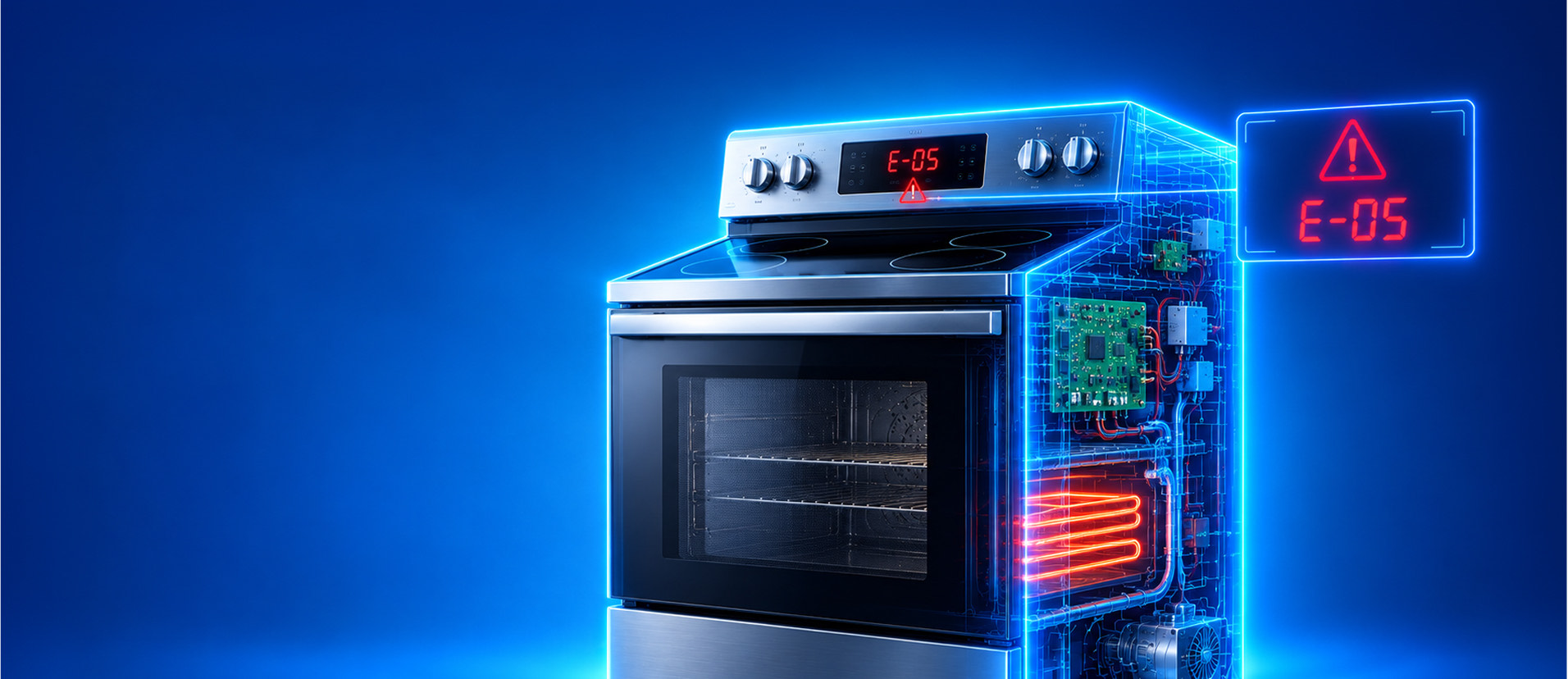
A range that beeps and shows a code starting with F or E has detected a fault, most often a stuck or shorted keypad, a failed oven temperature sensor, or a problem with the door lock after self-cleaning. Less often the control board itself has failed.
Write down the exact code and when it appears: at power-up, during preheat, or at random. The code and its timing together usually identify the part. Check whether the door lock light is on.
You can switch the range off at the breaker for one minute and turn it back on. If the code returns, do not keep resetting it. Send us the code and the model number and we can tell you what it means for your model.
Why does my gas range smell of gas?
A brief, faint smell of gas in the second or two before a burner lights is normal. A smell that lasts, a smell when every knob is off, or a strong smell at any time is not normal and must be treated as a leak.
If the smell is brief and only at lighting, check that the burner cap is seated and that the burner lights within a few seconds. If the smell lasts or the range is off, do not check anything else.
For a lasting or strong smell: do not touch any switch, do not light anything, leave the building, and call your gas utility or emergency services from outside. Any work on the gas supply is for a gas-qualified technician only.
Why does my range rock or tip forward?
A range that rocks has leveling legs that are not all touching the floor. A range that tips forward when weight is put on the open oven door is missing its anti-tip bracket, or the bracket is not engaged. That is a serious hazard, especially with children in the house.
Press down gently on the front corners and see whether the range rocks. Then check for the anti-tip bracket: it is fixed to the floor or wall behind the range and holds one rear leg down.
You can adjust the leveling legs until the range sits firm and level. If the bracket is missing or was not re-engaged after the range was moved, have it fitted before the oven is used again.
When should I stop and call a technician?
- A gas smell that lasts. Stop, don't touch any switch or try to light anything, leave the area, and call your gas utility or emergency services from outside.
- A melted or scorched power cord, plug or outlet, or a burning smell from behind the range. Switch off at the breaker and leave it off. A burned connection gets worse each time the range heats.
How do I keep my range working well?
Clean up spills before they bake on, and after cleaning, make sure the gas burner caps are dry and sitting square. Every few months, check the oven door gasket for gaps, tears or hardening. Don't line the oven floor with foil, which traps heat and can damage the element and the finish. After the range has been pulled out for any reason, check that the anti-tip bracket is engaged again.
How our diagnostic helps
Send us a photo of the model plate, a few photos of the range, and a short video of the problem. We work out which of these faults it is, give you a written repair plan with the likely parts for your exact model, and tell you plainly whether it's safe for you to fix.
A HandyManCan diagnosis costs $40, charged once, for one appliance and one fault. If we cannot reach a diagnosis, the fee is refunded in full.
Start a Diagnostic$40 one-time fee. No subscription. Full refund if we cannot diagnose it.
Questions about price, refunds or how it works? See our FAQs.
In Virginia's Shenandoah Valley? We also offer in-home repair.
Other Appliances
Washer not draining or spinning
Learn More
Dryer not heating or taking too long
Learn More
Refrigerator not cooling
Learn More
Freezer not freezing or frosting up
Learn More
Dishwasher not draining or cleaning
Learn More
Oven not heating or holding temperature
Learn More
Cooktop burner not lighting or heating
Learn More