


How to Get Started with HandyManCan — Step-by-Step Appliance Diagnosis Tutorial
Written by William A. Plumstead III, appliance technician. Published . Last reviewed .
The first question with any refrigerator fault is which part is warm. If the freezer is still cold but the fresh food section is warm, the cold is usually being made but not delivered, often a fan or a defrost problem. If both sections are warm, look at power, the condenser fan or the compressor instead. They are different faults and need different parts.
Why is my refrigerator not cooling at all?
When both the refrigerator and the freezer are warm, the cause is usually a power or control fault, a condenser fan that has stopped, or blocked airflow around the condenser. Less often it is the compressor, its start parts, or the sealed system.
Check whether the interior lights come on, and listen for the compressor or any fan running. Think about whether there was a recent power cut, or whether a door was left open.
You can check the temperature settings and make sure the doors close fully. Move the food somewhere cold. The cooling system itself is a technician's job.
Why is my refrigerator warm but the freezer works?
If the freezer is still cold but the fresh food section is warm, the cold is being made but not delivered. The usual causes are an evaporator fan that has stopped, or a defrost failure that has iced over the coil and blocked the airflow. Less often a damper is stuck closed, food is blocking the vents, or a door seal is letting warm air in.
Put a thermometer in each section. Look at the back wall of the freezer: heavy frost there points to the defrost system, and pressing gently and hearing a crunch means ice behind the panel. No fan sound with no frost points to the fan motor. On many models the fan stops when the door opens, so listen with the door closed or the door switch held in.
You can check the vents, the door seal, and listen for the fan. Taking off the back panel inside the freezer is a technician's job.
Why is there water inside or under my refrigerator?
Water inside the refrigerator usually means a blocked defrost drain. Water underneath usually means the drain pan, or the water supply line or its fitting. A door seal that doesn't close properly, or a defrost fault, can also cause water or frost where it shouldn't be.
First, notice whether the water is inside the compartment or on the floor underneath, because they are different faults. Notice whether it shows up after a defrost cycle, and check that the door closes fully. Frost building up where it shouldn't points to the door seal or the defrost system.
You can check the door seal by eye. If water is actively leaking from the supply line, turn off the water supply to the refrigerator.
Why is my ice maker not making ice?
An ice maker that makes no ice, or very small cubes, most often sits in a freezer that isn't cold enough to make ice. After that, the usual causes are the water supply, shut-off valve or filter, the water inlet valve, or the ice maker itself. Sometimes it has simply been switched off, or the arm is raised.
Check whether the water dispenser works. If it does, water is reaching the refrigerator and the fault is close to the ice maker. That one question narrows it a long way. Also check that the ice maker is switched on and when the filter was last changed.
You can check the switch, the arm, the filter, and the household water valve behind or under the refrigerator.
Why is my refrigerator water dispenser not working?
A dispenser that gives no water usually has a water filter that is overdue or not fitted properly, or a water line frozen in the door or freezer. Less often the water inlet valve, the dispenser switch or the control has failed, or the dispenser lock is on.
Check whether the ice maker still works. If it does, water is reaching the refrigerator and the fault is in the dispenser's path. Press the paddle and listen. A click with no water means power is reaching the valve but water isn't getting through, so it is either the valve or a frozen line.
You can check that the filter is seated properly and that the dispenser lock is off.
Why is my refrigerator making a buzzing, clicking or scraping noise?
A new noise from a refrigerator is often the evaporator fan hitting ice after a defrost failure. Other causes are loose mounts or tubing vibrating at the compressor, the compressor's start parts, a worn fan bearing, or the water valve and ice maker working.
Notice where it is loudest (inside the freezer, behind the refrigerator, or at the dispenser) and what kind of sound it is. Does it stop when you open the freezer door? Is there frost on the back wall of the freezer? Does it only happen when the ice maker fills? Are the temperatures still normal?
You can listen, record a short video, check the temperatures and look for frost. Don't remove panels, touch the fans or chip at ice. Heavy ice points to a defrost problem but doesn't prove which part has failed, so no one should replace a compressor or a defrost heater on the sound alone.
When should I stop and call a technician?
- Anything on the sealed system. The compressor, condenser, evaporator coil and refrigerant lines are under pressure and contain refrigerant. This is work for a technician with refrigeration certification.
- Ice on the evaporator coil. Never chip or pry at it with a screwdriver or a pick. The coil is thin and carries refrigerant, and puncturing it turns a defrost repair into a sealed-system repair. Let the ice melt with the refrigerator unplugged and the door open, with towels underneath.
How do I keep my refrigerator running well?
Vacuum the condenser coil and the rear vents twice a year, because a dirty condenser makes the compressor work harder. Every few months, check the door seals for gaps, tears or sticky residue and clean them. Keep food away from the vents between the freezer and the fresh food section so the air can move.
How our diagnostic helps
Send us a photo of the model plate, a few photos of the refrigerator, and a short video of the problem. We work out which of these faults it is, give you a written repair plan with the likely parts for your exact model, and tell you plainly whether it's safe for you to fix.
A HandyManCan diagnosis costs $40, charged once, for one appliance and one fault. If we cannot reach a diagnosis, the fee is refunded in full.
Start a Diagnostic$40 one-time fee. No subscription. Full refund if we cannot diagnose it.
Questions about price, refunds or how it works? See our FAQs.
In Virginia's Shenandoah Valley? We also offer in-home repair.
Other Appliances
Washer not draining or spinning
Learn More
Dryer not heating or taking too long
Learn More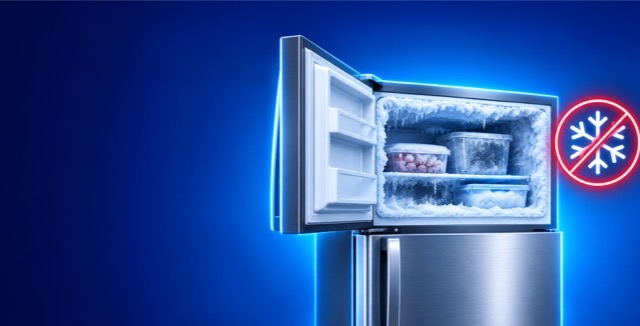
Freezer not freezing or frosting up
Learn More
Dishwasher not draining or cleaning
Learn More
Oven not heating or holding temperature
Learn More
Range dead or showing an error code
Learn More
Cooktop burner not lighting or heating
Learn More